
Bexar County Sex Offender Checks
The official starting point is the Texas Public Sex Offender Registry, which Texas DPS maintains under Code of Criminal Procedure Chapter 62. It can answer a name-based question or show records near a Bexar County address. Searchers should compare more than a name. Date of birth, photograph, physical description, address, reporting agency, registration status, and verification date help separate people with similar names.
Choose the search that fits the question. A county filter gives a broad Bexar County view. A city or ZIP filter narrows the area, while an address-and-radius search is more useful for a specific block. Read every result as an administrative registration record. The underlying court case supplies the conviction or adjudication, and a current registry status matters more than an old screenshot.
Bexar Name and Radius Searches
Name and map searches solve different problems. A name search helps confirm whether a known person appears in the Texas registry. An address-radius search supports community awareness around a home, park, school route, or family destination. It may also reveal a record registered through a nearby city agency rather than the Bexar County Sheriff's Office.
Do not treat the map pin as survey-grade proof. Check the written address, reporting agency, and verification details on the profile. A registrant may have more than one reported location category, and the registry can change after a move or verification event. If a Bexar County result seems stale, note the profile's reporting authority before calling.
Texas Public Registry Searches
The registry form supports both identity and place-based research. Start with the least broad set of facts that can still find the record, then add a county, city, or ZIP filter if results are crowded. Avoid assuming that a no-match search proves no duty exists. Spelling, aliases, a recent move, an out-of-state duty, or a record update can affect the result.
- Open the official Texas DPS registry and choose a name or geographic search.
- Enter the known name, address, city, ZIP code, or select Bexar County.
- Set the radius shown on the live address panel when proximity matters.
- Compare the result's photograph, identity details, status, reporting agency, and verification date.
- Open the underlying profile and confirm any unclear fact with the listed registration authority.
| Field | Use | Search note |
|---|---|---|
| Last and first name | Identity search | First name narrows a surname result |
| Address and radius | Nearby records | Use the live distance choices |
| City or ZIP | Local filter | Useful within greater San Antonio |
| County | Countywide list | Select Bexar |
| Map or list | Result view | Compare pins with profile text |
The DPS registry search screen shows how these fields work together.
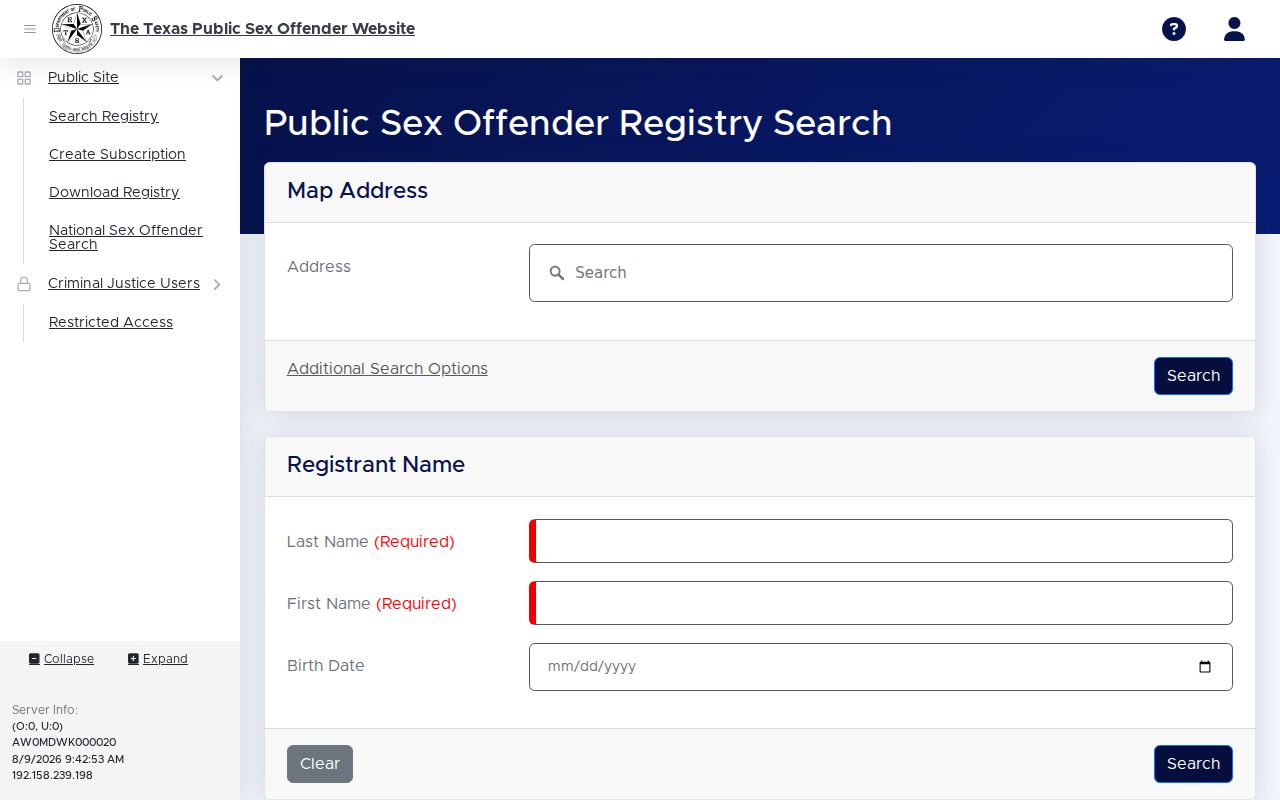
The screen is the public lookup channel. It is not the office used to schedule a Bexar County registration appointment.
Bexar Registry Profiles in Context
A profile combines identity facts, registration facts, and offense information. Those groups should not be blurred. Physical features help confirm identity. The address and reporting agency show where the registration is maintained. Offense, court, date, and disposition fields describe the event that led to the duty. Verification and status fields help show whether the entry is current.
A profile may collect more data than it displays. Texas law controls public access, so absence of a vehicle, school, or other field from public view does not prove the agency never collected it. Likewise, a listed victim age or category should be read only as displayed. Never infer or identify a private victim.
Bexar Registry Profiles: What They Show
Use the profile as a set of cross-checks, not as a label. The Texas public display can include the following field groups, though the exact fields vary by record.
| Identity | Legal name, aliases, birth or age information, sex and race |
|---|---|
| Appearance | Photograph, height, weight, hair, eyes, scars, marks and tattoos |
| Location | Public address details and the agency receiving reports |
| Registration | Status, verification information, and reporting details |
| Offense | Description, statute, court, state, date and public disposition fields |
| Other public data | Vehicle, school, or other registration details when legally displayed |
When two fields conflict, save the URL and contact the reporting authority. The local office can check its source record, while DPS controls the statewide public display.
Bexar Registration Office Appointments
The Bexar County Sheriff's Office command directory lists Sex Offender Registration at 210-335-6077. The unit operates within the sheriff's Criminal Investigation structure at the Comal headquarters complex. Call before traveling to learn the current location, required documents, appointment process, and reporting instructions. Public registry search staff and registration staff serve different tasks.
BCSO Sex Offender Registration
Bexar County Sheriff's Office
Comal headquarters complex
San Antonio, TX
210-335-6077
Call for current appointment and reporting instructions.
A suspected failure to register should go to the local registration authority or law enforcement. Use 911 only for an emergency. Provide facts such as the profile, location, date, and conduct observed. Do not confront the person or post accusations based on an unverified map result.
Registration Levels and Duties in Texas
Texas does not replace Chapter 62 with a simple public low, medium, and high tier chart. The offense and judgment drive the length of duty. Many listed offenses carry lifetime registration. Other duties can last ten years after release, discharge, or the statutory starting point. Juvenile and out-of-state cases have their own rules, and a court order may matter.
| Duty pattern | Duration | Public reading |
|---|---|---|
| Specified lifetime offenses | Lifetime under Chapter 62 | Confirm the exact offense and profile |
| Specified ten-year offenses | Ten years after the statutory start | Do not count from the search date |
| Juvenile duty | Depends on juvenile provisions and orders | Separate rules apply |
| Other-jurisdiction duty | Texas and originating law can interact | Confirm with the registration authority |
Verification is commonly annual, but certain classifications can require more frequent reporting, including a 90-day schedule. A federal SORNA tier is not the same as a Texas risk assessment or a Texas statutory duty. Guessing a tier from an offense name can produce the wrong result.
Bexar Verification Dates Matter
A registry check is a point-in-time view. Read the last verification date, status, and reporting agency before relying on an address. Annual and more frequent schedules do not mean the public page changes on a fixed day. Moves, agency review, and data transfer can create a gap between an event and a visible update.
If a Bexar County profile appears old, contact the listed reporting authority. Give the profile URL and state the field that seems wrong. DPS manages the public database, while a sheriff or police registration unit may own the local source fact. That split explains why the correct first call depends on the profile.
NSOPW Beyond Bexar County
The National Sex Offender Public Website is useful when a search crosses state, tribal, or territorial lines. It brings participating public registries into one federal search layer. It can also catch a nearby entry missed by a Bexar-only county filter. Return to the source jurisdiction's profile for the controlling detail.
The national search interface illustrates that cross-jurisdiction role.
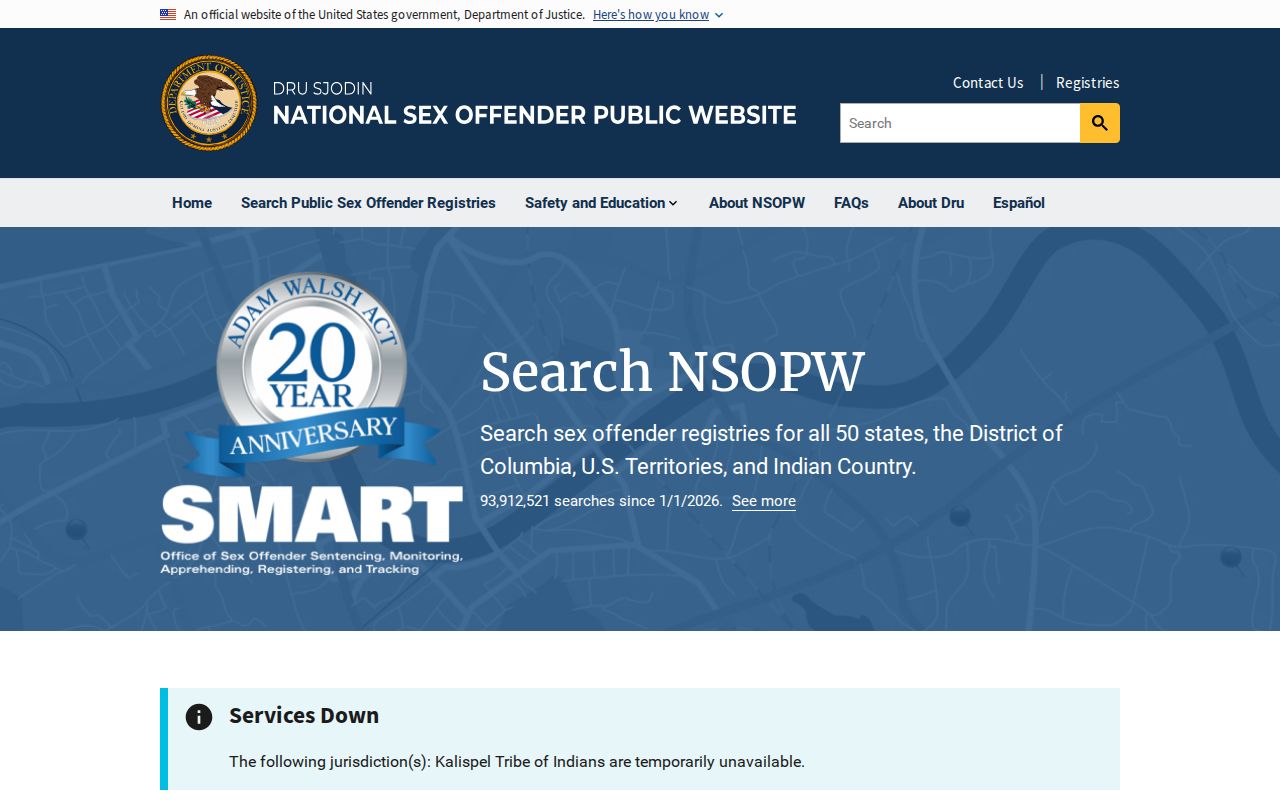
NSOPW broadens reach, but the Texas profile and the named local authority remain the best sources for a Bexar County record.
Bexar Residence Rules Need Care
Texas has no single statewide distance rule that applies to every registrant in every setting. Parole terms, community supervision conditions, court orders, and city ordinances can add distinct limits. A map distance alone cannot establish a violation. Check the person's controlling order and the rule for the exact city.
Converse, for example, publishes local provisions with different distances for different subjects. Those provisions should not be projected onto all of Bexar County. The same care applies to school zones, parks, child-safety zones, and property rules. Ask the responsible local office when a boundary or legal basis is unclear.
Using Registry Information Lawfully
Registry data supports personal, family, and community safety planning. It does not grant a right to confront, threaten, stalk, shame, or injure a registrant or household member. A profile should be checked against its source, especially before sharing a claim with others. Community notification depends on status and statutory triggers, not on a private reader's assumptions.
Misuse is unlawful: Texas DPS warns that registry information may not be used to injure, harass, or commit a crime against a registrant. Misuse can lead to criminal or civil consequences.
For a possible reporting violation, contact BCSO Sex Offender Registration, the city registration authority named on the profile, or law enforcement. Preserve the public link and describe the suspected noncompliance. For immediate danger, call 911.
Correcting Bexar Registry Details
A person reviewing their own profile should start with the reporting authority named in the entry. Bring or cite the source document that shows the claimed error, such as a court order, release paper, or address record. The local authority can compare that item with its registration file. DPS manages the statewide display, but it cannot safely replace a local source fact on an unsupported claim.
For a public report, save the profile URL, note the disputed field and verification date, and give the authority concise facts. Do not publish an accusation. If the issue concerns the conviction itself, the originating court file is the source for the judgment and disposition. That source-first process helps preserve both safety and accuracy.